


What the Netflix button on my remote taught me about building

Last week, I was on Substack when I saw a post that arrested my attention.
It was from one of the co-founders of Netflix.
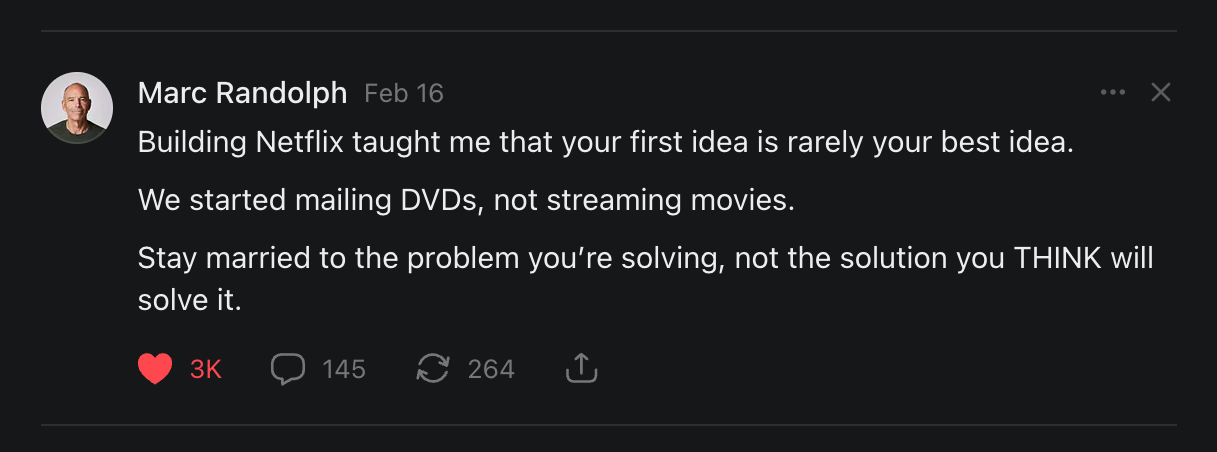
This hit me because I’d been questioning my marketing tool.
I built it out of curiosity to solve my own problem. I got excited that others might want it too. Then I started seeing similar solutions everywhere. Other entrepreneurs way ahead of me, customers building their own in-house versions, AI companies releasing updates that made mine feel irrelevant, even crashing stock prices of public companies.
“Oh I have no chance in this game.”
I was losing steam.
Then I saw that note and remembered that Netflix started in 1997 mailing DVDs. Now there’s a Netflix button on my TV remote (even if they just lost the bid to purchase WB). They’ve been solving the same problem for 27 years – convenient access to media – but the solution evolved from envelopes to apps.
I was focused on the wrong thing: my solution, not the problem itself.
Become solution-agnostic, not problem-agnostic
Don’t be too in love with your solution. Fall in love with a problem you can’t shake off.
When you focus on the problem, it becomes your guide – showing you multiple paths forward instead of tunnel vision on one approach.
I built a marketing tool over Christmas, spent January demoing it to founders. By the time I was ready to iterate, Anthropic released Cowork, Skills came out, OpenClaw emerged. I felt that familiar panic: “Is what I’m building even relevant anymore?” At the pace we’re moving, it’s very easy to give up. I feel like I’m always just catching up.
But once the hype died down, I realized there were still a lot of people interested in what I was building. I just happened to be in a solution bubble.
The problem I was solving – helping founders overcome resistance to sales, and build their business – hadn’t changed.
The solution might need to evolve, but the problem remained sticky.
I’ve seen this solution-gaze with aspiring authors that I coach too. They say they want to write a book, but the real problem is being known, having a platform, or building creative discipline. These are problems a book could solve, but so could a newsletter, a podcast, or a community event.
The problem exposes the solution, not the other way around.
Narrowing down on the solution too early squeezes your field of vision, where you don’t even know if there’s a problem to start with.
This approach becomes a huge time-waster. You spend more time building something not a lot of people need, convincing people to solve a problem they don’t actually have, and wasting energy on a path that has already shifted faster than a Usain Bolt dash.
Letting go of the sunk cost is a huge challenge but holding on is actually more costly.
I spent the first year of my first business convincing people that they needed to share their knowledge behind a pay-walled community. When entrepreneurs just needed a partner and insights to help them avoid mistakes as they expanded into emerging markets.
What I noticed is that when I was solution-focused, I defended my approach even when the market said otherwise. It felt self-protective at the time, but it was actually self-centered.
It screamed “Everyone needs to conform to what I built.”
When you’re problem-focused, you conform to what people actually need. The problem directs the solution, not the other way around.
I hear the gurus yelling: “Find your passion. Fall in love with your solution. Believe in your vision. Don’t let anyone tell you it won’t work.”
I’ve learned something different: Fall in love with the problem. Be willing to change your solution completely if it doesn’t serve that problem.
Netflix didn’t stay married to DVDs. They stayed married to convenient media access.
Now I click and watch horrible episodes of Love is Blind.
I’ve learned that as you find problems to solve, you also have to start with solving problems that make it sustainable for you to continue solving that problem. What you’re building might not just be it.
What you need is a quick stress test.
The 10 solutions stress-test
Here’s what I’m noticing on the practice ground: The fastest way to know if you’re married to a solution (not a problem) is to force yourself to imagine 10 different ways to solve it.
If you can only think of one way then the thing you’re currently building is too solution-focused, not problem-focused.
Here’s what I did this week:
When I asked myself “What problem am I actually solving?” It forced me to go back to the core problem: Founders resist doing sales consistently and feel the “ick” towards marketing (even though it’s essential for growth).
That’s the problem. The tool is just one possible solution.
So then I listed 10 possible solutions to the problem:
Marketing tool that automates selling
Fractional sales support
A sales coaching program for founders
Connecting founders to their audience through events
Building a network of founders that introduce one another to their network
Book about overcoming resistance
Becoming a certified therapist that coaches through resistance
Creating an accountability tool and partnerships for sales activities
Developing a clarity agent that knows exactly what actions founders need to take
Starting a coffee shop that builds community for founders to practice together
My current tool (#1) is one path. But seeing 9 other viable solutions freed me from defending it. The tool became a means, not an end.
Now it’s your turn: What’s the problem you’re solving? (Write it in one sentence)
Week 1: Write 10 different ways you could solve it. Force yourself to get to 10, even if some feel strange.
Compare your current solution to the list. Is it the best way to solve the problem or are you just attached to it because it’s what you started building?
Week 2: Interview 3 customers about which problem each solution best serves. (Feedback is important)
Week 3: Build the simplest version of your top 2 candidates. (Action is the most important)
Talking to people is the best way to know whether you are solving problems for people. Get out there to stay anchored to what actually matters.
Closing Reflection:
I still remember back in Chicago, when I got the first Netflix DVD in a paper envelope. I thought there’s no way this would last or take over my sister’s blockbuster subscription (which I was borrowing then). But now there’s a Netflix button on my remote control in my apartment.
The Netflix story stayed with me for a reason because it showed me that problems are patient. Solutions are temporary.
If you’re feeling trapped by your current approach, that’s actually good news. It means the problem is bigger than the solution you’re defending. Which is exactly where the real work begins.
So here’s the question I have for you today: how can you become more oriented on the problems people have that bring you more focus today?
Yours truly,
Nifemi
P.S. Just do it. Don’t overthink. Hit reply and write one sentence to the problem you want to solve. I read everyone, and I might just make a necessary connection to get you going.