

I had to fail over and over again to learn this
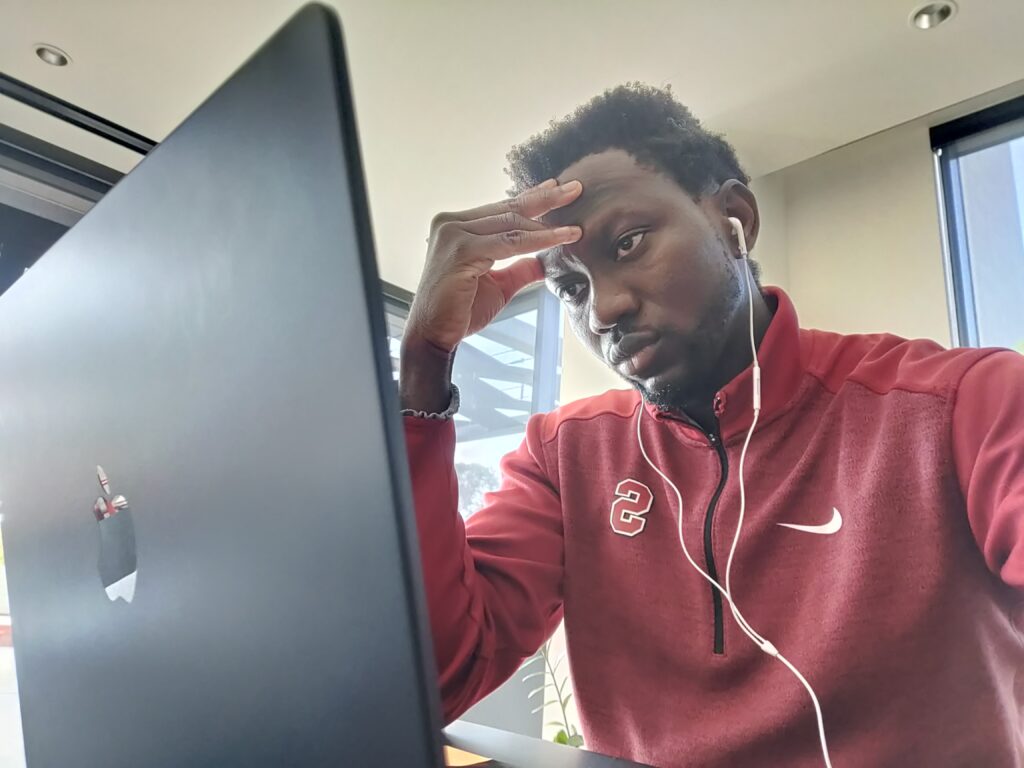
I was on my phone at the back of class, checking whether my developer had updated the menu of my website.
I was obsessed with what I was building – a knowledge-sharing website that I prototyped just before business school ate up most of my attention. I had hired a developer in Germany and a designer in Australia while sitting in class in Palo Alto, checking my phone instead of listening.
I was here for global trade. Doing it big. Taking on all risks. Swinging for the fences.
A year later, I was just a broke student.
I had moved on from a website, through a summer internship stint at a Ghanaian furniture factory, to now building an app. More money out of my pocket, not much coming in.
But it was worth it. “You have to take huge risks for huge rewards.” That’s what I told myself to keep going.
Then in one of those classes where I actually paid attention, one of the teachers, who was an entrepreneur-turned-investor, said something that changed how I thought about things.
He said from decades of working with the most successful entrepreneurs, there’s one attribute they all have.
I was at the edge of my seat, thinking “They go all in right? They are passionate. They risk it all?”
He said, “Their biggest gift is that they are risk minimizers.”
“What?”
He continued, “they learn every step along the way how to minimize risk.”
It went against everything I had heard and has changed the way I approach things in life and business.
When striving for less is more rewarding.
The world tells you to strive for more, I say do the opposite. Strive for less.
Since I heard that insight about the most successful entrepreneurs from that investor, I saw it everywhere. From entrepreneurs, mentors, and even clients I worked with.
What I realized is that these experienced entrepreneurs and business developers, entering new, complex markets, filled with risk, don’t have a higher risk tolerance. With experience they have higher awareness of what can actually kill their business. So they focus their energy there, not everywhere.
I’ve seen this in my business too.
With every new year, I learn what not to do.
When I got my first deal, I was happy, then I spent three months, heads down, executing. By the time I was done, I thought “dammit…I need to close another deal.” It took another 3 months. I learned about the long sales cycle and the risk it posed to my business.
The following year, I got a better grasp of it and started frontloading sales the year before and at the beginning of the year to reduce risk of a sure cashflow shortage. Now this didn’t remove all the risk.
I couldn’t insulate my business from the risk of a global pandemic halting my business as well as the business of others.
However, I had a sense of what I didn’t need to waste my time on like selling to companies that had laid people off or cut the salary of their entire workforce. The “Nifemi from 5 years before that” would have been trying to sell to everybody with no sense of risk because that’s how I had been trained from school to the corporation.
That constant strive for more – better grades, bigger salary, next title, unicorn growth.
It’s easy to follow the maximizing treadmill, but you can end up in a self-imposed wilderness chasing something intangible, when you could be reducing something tangible.
This isn’t an anti-growth rant.
Far from it. I’m only focusing on the internal game that happens with growth – the part no one talks about. The consistent practice of chipping away at the unpleasant and how you deal with it to get marginally more reward (pleasant) consistently.
Because even though the main narrative out there is about entrepreneurs growing their businesses, the communities I’m in, I’m surrounded by entrepreneurs and business owners, dealing with shit just to keep their business alive.
The ones that make it through, might not make it to your LinkedIn feed or your local magazine, but they’ve learned a very important practice, one where striving for less is more.
This doesn’t come natural, so I’ve had to develop minimization as a practice.
On the ground – the “current state” exam.
Vague ideas get you nowhere.
That’s why I’m experimenting with this framework: asking what current states I’m sure of.
There are a few – anxious, overwhelmed, distracted, regretful, cautious, inspired, ready to act, curious, unsure.
Here’s what I’m noticing when I try it – it’s uncomfortable.
However, being honest and reflective grounds you. Then I took one of those states and asked – which would I want to minimize?
“Regretful.”
A lot of times, you hear people towards the end of their life being filled with some form of regret or the other. So I’ve been experimenting with minimizing regret.
This is not only a long term exercise.
I’ve started using it to make decisions daily. For instance, I recently finalized the accounting of the past year of my business. It helped me gain more clarity on how I wanted to grow.
With that in mind, I could reverse engineer how many sales calls I had to have per month to hit my goal. It came down to having one call per business day. So far, I haven’t been hitting that goal. “Am I very worried about it now?” No.
But using the minimization framework I’ve asked myself: “Will I regret not hitting my sales goal if I didn’t stick with the plan to get there?”
The answer is yes.
So to minimize my regret, I need to book and lock down those calls.
The minimization approach is very subtle but it’s concrete and can inspire action.
This week, try it: Pick one thing (an internal state) in your business, project, or career that’s eating time without delivering results.
That’s your minimization target.
Closing Reflection
Ever since I was that broke business school student listening to my investor-professor talk about the entrepreneurial gift of risk minimization, I’ve always thought about the counterintuitive way to get what you want in life.
While the world bombards you with maximization messages to get more, strive to extend, and chase what looks good on LinkedIn.
Minimizing unpleasant states you’re aware of is often more rewarding. You don’t need to chase illusions.
This leaves me with a question for you: what would you be willing to minimize to get what you actually want?
Yours truly,
Nifemi
P.S. Help me minimize the void I hear when I can’t tell if anyone read this far by clicking the like button, replying or commenting below 🙂