

The manufacturing lesson I learned over a decade about where value truly lives and how to create your unfair advantage
I’m done keeping up with AI.
Not because I don’t like learning. Because I learned something a while back that reminds me of what I’m seeing.
I came to the humbling realization a few weeks ago that I can’t keep up with the pace of AI development. Have you felt it? The dizzying speed at which the space is advancing. I built and launched a marketing tool. A few weeks later, Anthropic released a feature that made the main value proposition of what I built useless.
I’ve spent the last week really exploring what’s important to what I’m building and for who.
Asking myself, “at what point do I say, ok, sunk cost, let’s keep it moving?” I get the same sentiment that most people are struggling to keep up too. Midway through that exploration, an insight surfaced.
It’s called the smile curve of the supply chain from manufacturing. Eighteen years in manufacturing and supply chain taught me something about where value actually lives.
Software is entering its manufacturing era. The value accumulates at the edges.
There’s nothing different here. Same principle, just a new set of tools.
This gave me a compass on where to spend my time that’d bring the most value.
One insight: Where Value Actually Lives
Your past experience is often a compass when the present gets noisy.
As I searched for an image of this smile curve online, I searched “the three flows of supply chain.” I found an article that I wrote 11 years ago, quoted by AI. I knew that article ranked high when I wrote it back in business school but I was surprised it still ranked number 1 on google. I hadn’t updated it. It was now quoted by AI.
I didn’t have to buy any AEO or GEO service – and all the new jargon – that’s being sold by these new school AI SEO gurus.
It was a good reminder that what you know and have done in the past is enough. Especially if you can spot patterns.
This is even more important as technological advancements are moving at breakneck speed.
“Should I be prompting my way through features?”
“Should I go work for an AI company?”
“Will AI replace me?”
These questions live on the minds of everyone. But when experience shows you that you’ve seen this in some form before, it can bring some calm, or at least a much-needed perspective.
That’s what happened when I used my experience in manufacturing to think about the future.
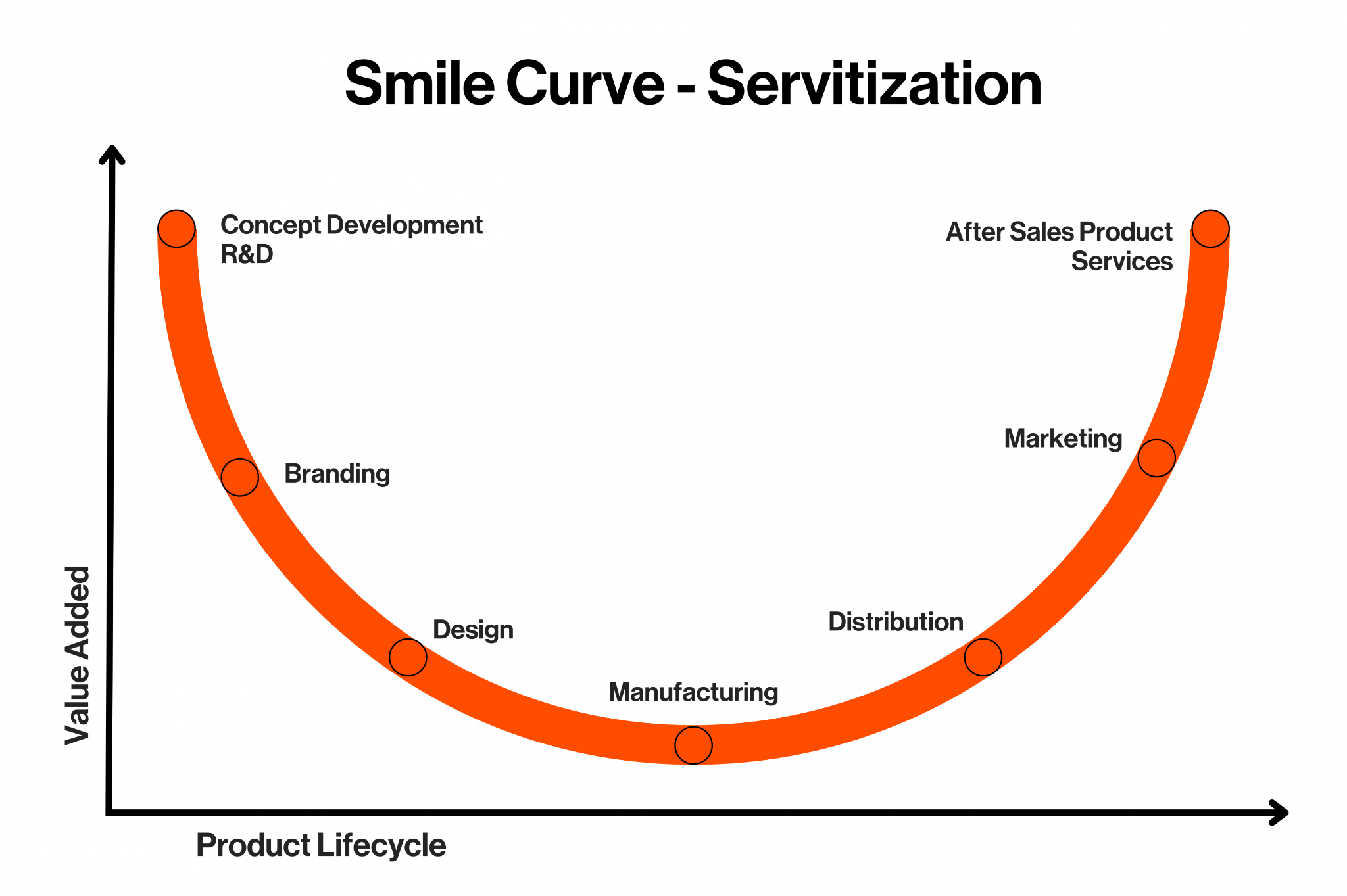
The smile curve shows that value is highest before and after production – in R&D, design, marketing, and after-sales service.
Manufacturing itself? Low margin, high volume grind.
The classic case to explain this is Apple. Every Mac laptop has a small print “Designed in California.” But each one, made in China. You and I know how good Apple’s marketing is and how much they put into the retail experience. Apple captures most of the value on the IP, design, customer experience. While the large-scale assembling of their products – outsourced to Foxconn, the world’s largest electronic manufacturer.
There’s a chance the same would happen in AI and software.
AI allows everyone to build. This reduces the “value of building,” moving that value into high leverage activities such as R&D, design, marketing, and after-sales service. Building software will only be valuable if you can do high volumes (like Foxconn). That’s where the Anthropics and the big software agencies will play and most likely win.
So where does that leave someone like me who doesn’t want to be Foxconn?
My instinct was to double down – build faster, keep up with the feature race, compete in the commodity middle.
Then the smile curve showed me something clearer – that’s where the margins die. Apple doesn’t win by manufacturing better. They win by owning the edges.
It helped me take a step back from the feature arms race. Instead, I’m focusing on building my own form of IP, designing processes, getting better at marketing, and offering unique customer experiences to build something that withstands the ever-increasing noise, and build for longevity.
The lesson here isn’t about supply chains. It’s about finding value away from the noise.
I’m still going to build but maybe the best use of my time isn’t a race to the bottom of building things that can easily be replicated. This realization brought me immediate peace of mind.
I only got there with an analogy from my past experience – one that has helped me look at what’s happening now with a fresh perspective.
When you don’t use your experience or analogies, everything looks new. You feel like a fish out of water, stuck not knowing what to do.
This causes a vicious cycle because, while you’re stuck as others participate, you don’t practice or gain experience. So when the next wave comes (and it will come), you’ll be stuck there again not knowing what you’re looking at or what to do.
Value concentrates where competition can’t easily commoditize.
The question is – where do YOU have unfair advantage?
Because spotting these connections is what gives you that edge.
But here’s what’s not intuitive – most people don’t do this work. They wait for the pattern to be obvious.
Building a Bank of Analogies.
Here’s what I’m noticing in the practice ground: the most creative people are good at practicing pattern recognition.
I dug into my own history. I pulled an insight from manufacturing and asked, ‘Does this apply here?’ It did.
That’s the practice I want to highlight – building an analogy bank.
I do this all the time, it’s annoying. Before generative AI came around and everyone started “prompt writing,” I used to get more questions about my writing like: “so how do you write so consistently?” I didn’t really have an answer, so I’d use analogies. “Writing is like playing basketball…just keep bouncing the ball.” “Writing is like running a scientific experiment…you never know what will work.” I mix all my interests together. “Making beats is like building a book…the drums are the basic idea and then you layer everything over that.”
I can go all day.
I might force these analogies, but I truly find patterns of similarity.
I do this daily. You have to be open to it like a stand-up improviser on stage.
Here’s how I’d start building that muscle if I were you:
Understand the three things that make an analogy: a source (the thing you know), a destination (the unknown that you want to know better), and a vehicle between the source and destination (the analogy or metaphor).
Find your sources: List three things you’ve experienced in your life over the last ten years. This could be work experience, personal interests, something you read in a book.
Spot destinations: Choose a new thing you want to learn. That’s the new thing you’re curious about. Write it down.
Make a connection: Connect the source with the destination, using a sentence like: “The {insert destination} is like {insert source} because {insert why}”
Write down the first thing that comes to your mind to complete that sentence.
Do this five times. Write them down.
Here’s an example:
Source: Managing my writing habit.
Destination: Building consistent AI feature development.
Connection: Building AI features is like writing daily – you don’t wait for inspiration, you show up and let signals emerge.
It will be difficult at first. It will feel unnatural and forced. With time, you start spotting patterns linked in your memory base.
Ultimately making you a better creative thinker and problem solver.
There is a lot of calm and agency that comes when you know you have the foundation to create value in any time, or era.
Closing Reflection:
I’ve realized from a decade of building that nothing is truly original.
Things just get recycled, renamed, combined. New things are just the combination of old things, and you’ve embedded through experience. A lot of us just forget them, caught up in the noise.
But if you take some time to slow down to ask the right questions, perhaps it will lead in a clearer direction than the quest for “right answers.” The practice ground is where you learn that nothing is truly new. It is just better understood through the lens of what you’ve already built.
My question for you today is: “What signal from your past five years could completely reframe what’s happening in your field right now?”
That question might just give you the perspective you need to thrive in this era.
Yours truly,
Nifemi
P.S. Reply with one word – did the smile curve help you rethink anything today?